Edin Dzeko at 40: How the Bosnia Captain Defied Age to Lead at World Cup 2026
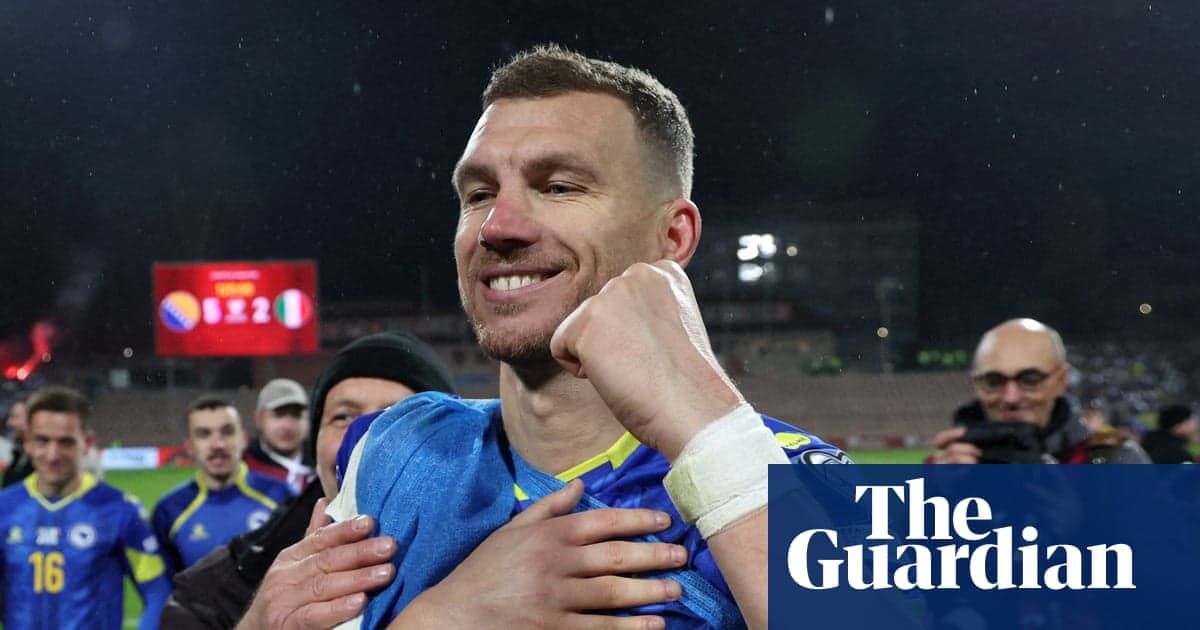
Source: i.guim.co.uk
Edin Dzeko, at 40, leads Bosnia in only their second World Cup, defying age with mental discipline, advanced training, and strategic tactical deployment, joining a seven-strong over-40 cohort.
Edin Dzeko is a man who has weaponized experience. At 40, the Bosnia and Herzegovina captain is preparing to lead his nation into only their second World Cup, a feat that even he admits he never saw coming. “If you asked me 10 years ago, I would have said ‘no’,” Dzeko confessed, reflecting on his remarkable longevity. According to a feature in The Guardian, the striker is now part of an elite club of seven fortysomethings at the tournament, a group that includes global icons Cristiano Ronaldo and Luka Modric. But unlike the galacticos chasing immortality, Dzeko’s mission is more immediate and perhaps more visceral: upsetting co-hosts Canada in their opening match on Friday and proving that a career built on relentless dedication can peak on the biggest stage of all
As the Sports Illustrated
piece notes, playing past 35 was once a rarity reserved for goalkeepers or genetic anomalies, but Dzeko’s presence signifies a paradigm shift in elite football, where science and savvy are extending final chapters far beyond what was once thought possible.
The Science of the Seventeen-Year-Old Mindset
It is tempting to frame Dzeko’s longevity as purely physical, but his own words suggest the battle is fought largely in the mind. The Guardian’s sit-down with the striker reveals a man who has reconfigured his relationship with his own body through a lens of mature humility, contrasting sharply with the naivety of his teenage years. Dzeko recalled being told as a youngster that experience is something you accrue simply by playing for many years, a concept he now dismisses with a knowing grimace. “When you think like a 17-year-old,” he told The Guardian, screwing up his face, before concluding with a smile: “But when you arrive at this age you know experience is fundamental.”
This mental evolution is what separates the fleeting careers from the enduring ones. The Sports Illustrated analysis delves deeper into the scientific underpinnings of this trend, explaining that playing past 35 was once almost unthinkable for outfield players unless your name was Paolo Maldini. Now, the article argues, advances in nutrition, elite training methods, and the relatively new concept of “prehab”—injury prevention work—have redrawn the boundaries of a footballer’s lifespan. Dzeko embodies this modern archetype. He isn't merely surviving on muscle memory; he is obsessively listening to his body, a stark contrast to the indestructible mindset of youth. His regime, which he describes as significant work before and after training to care for his aging legs, is a far cry from the raw, untamed potential that saw him sold from the Sarajevo-based Zeljeznicar to the Czech league as a teenager with limited elite prospects.
The Golden Old Guard: A Tournament of Farewells
While Dzeko focuses on shocking the hosts, he is navigating a tournament drenched in nostalgia for aging legends. The Al Jazeera preview casts the 2026 World Cup explicitly as the final swansong for the sport's greatest talents, branding it the “final act” for figures like Lionel Messi and Cristiano Ronaldo. At 41, Ronaldo is highlighted as the second-oldest player at the tournament, with only Dzeko himself carrying more candles on the birthday cake. The Portuguese forward, still lethal with 30 goals in 37 matches for Al-Nassr last season as reported by Al Jazeera, has long targeted playing past 40, a goal Sports Illustrated describes as “mad” when he first voiced it in 2016.
Dzeko finds himself in parallel company. The Guardian identifies seven players over 40 who could feature this summer, and drawing comparisons between Dzeko, Modric, and Ronaldo is inevitable. However, there is a critical distinction
While Ronaldo and Messi
carry the weight of being the focal point of title contenders, Dzeko’s role is that of the talismanic underdog, the symbol of a nation that shocked Italy in the playoffs to reach this stage. Unlike the heavily scrutinized fitness of stars whose tournament exits will be framed as the end of an era, Dzeko’s narrative is already defined by defiance. He has already won, simply by making it to this point when, 10 years ago, he was certain his body would have stopped him.
Star Players in Doubt and the Fenerbahce Factor
Yet, the line between a glorious run and a painful limp across the finish line is perilously thin for the forty-something generation. The Al Jazeera report explicitly notes that while some players are set to record men’s football history in their sixth World Cup, age is inevitably catching up, and several stars have struggled with injuries heading into the tournament. This reality hang over the entire field of veteran players. For Dzeko, the physical management is an hourly commitment rather than a daily one. His move to Fenerbahce was a calculated step to maintain dominance in a competitive league while conserving energy for moments like Friday's clash against Canada.
The Bosnia captain’s approach validates the Sports Illustrated thesis: “prehab” and recovery aren't just second-career luxuries—they are survival tools. The image of the young Dzeko being dismissed by Zeljeznicar before embarking on a journey through Europe’s elite leagues in England, Italy, and Germany proves that physical talent only takes a player so far. The capacity to adapt to physical decline while leveraging mental sharpness is what allows a 40-year-old to start a World Cup match against a team backed by a partisan home crowd.
Tactical Analysis
The selection of a 40-year-old striker in a Group of Death scenario forces a specific tactical recalibration for Bosnia and Herzegovina. Against a youthful, high-energy Canadian side determined to perform as co-hosts, Dzeko cannot operate in a high-pressing system that demands explosive sprints over 90 minutes. Instead, Bosnia’s strategy will likely revolve around a low to mid-block designed to absorb early Canadian pressure, with Dzeko functioning as the ultimate release valve. His experience, which he deems “fundamental,” becomes the primary tactical weapon to disrupt Canada’s defensive organization, transforming half-chances into goals in a way that unproven, younger forwards cannot. If Dzeko can force an opening-match result against Canada, it destabilizes the group's hierarchy and opens a legitimate knockout-stage path for Bosnia, directly punishing the co-hosts on their own soil. This tactical dependency on a fortysomething’s composure is the most compelling consequence of Dzeko’s defiance, proving that while science may have extended his career, it is cunning that will define his World Cup legacy.
The Bigger Picture
Edin Dzeko’s unlikely World Cup appearance dissolves the traditional narrative of the aging athlete as a fading memory. Rather than a ceremonial farewell tour, his participation represents a strategic imperative born from a career-long battle against the odds. From being discarded as a raw prospect at Zeljeznicar to shouldering the hopes of a nation that defied Italy to reach North America, Dzeko’s path forces a reevaluation of what veteran leadership looks like in the modern tournament structure. His collision with the explosive structure of the Canadian co-hosts will not just test his aging ligaments; it will test the theory that elite football’s obsession with youth can be momentarily subdued by a mind that has finally understood what it means to compete. When he leads his side out, Dzeko won't just be proving that 40 is the new 30—he will be demonstrating that for a nation once considered an outsider, the most dangerous weapon is a player who has nothing left to lose because he already surpassed every believable limit.
Sources & Further Reading
- https://www.foxsports.com/watch-vertical/fmc-lf9iz5ap5fiej8s8
- https://www.si.com/soccer/how-soccer-stars-defy-old-age-reach-another-world-cup-digital-cover
- https://www.aljazeera.com/sports/2026/6/4/ronaldo-messi-at-world-cup-who-else-is-playing-their-final-tournament
- https://www.theguardian.com/football/2026/jun/09/playing-at-40-edin-dzeko-bosnia-and-herzegovina-world-cup